STRETCHING
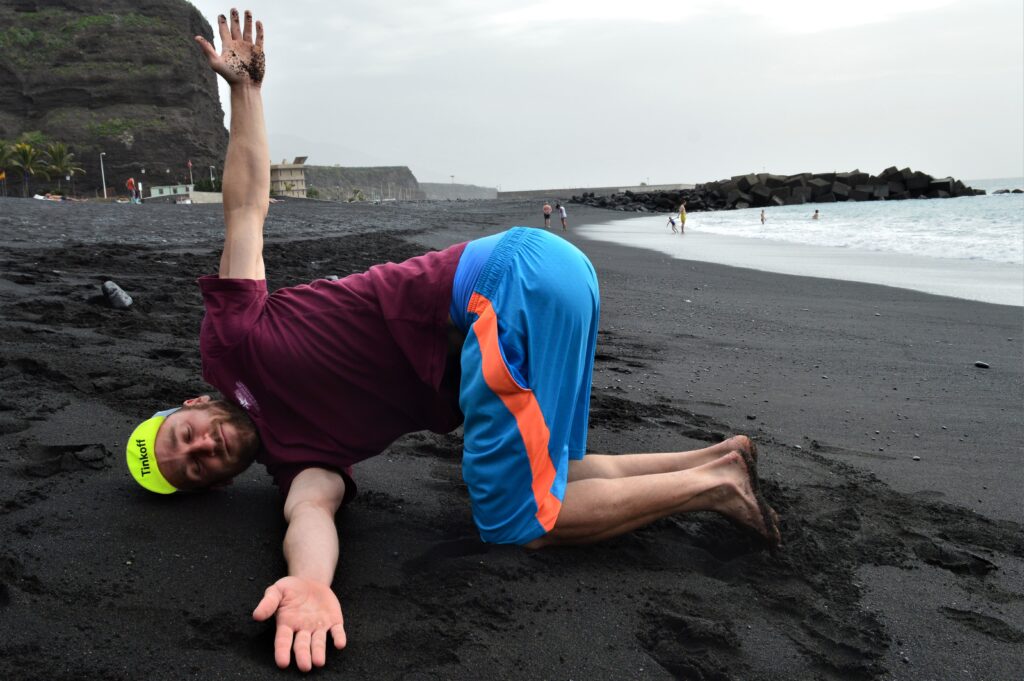
‘After training is before training.’
There are different opinions on the subject of stretching. Depending on how you feel about it, you can try out exercises here or not. I present options for the whole body, as well as people who use stretching, fascia rolls and other techniques to relax the body.
Take a look and give it a try. If you don’t like it, you can leave it out.
.
Liebscher & Bracht
Liebscher & Bracht have spent years researching the topic of fasciae and have created their own exercise programme to counteract osteoarthritis and misalignments. Their books, ‘The Osteoarthritis Lie’ and ‘Germany Has Backs’ explain their knowledge and the functions of the exercises.
The exercises are relatively simple, can sometimes be integrated into the daily routine and require little or no equipment to perform. You already have several doctors throughout Germany who use your exercise programme.
In the links below the photo you will find exercises for stretching and fascia rolling the whole body. I do some of the exercises for my knees, hips and back and can highly recommend them. Enclosed you will find the website, as well as the YouTube and Instagram channel:
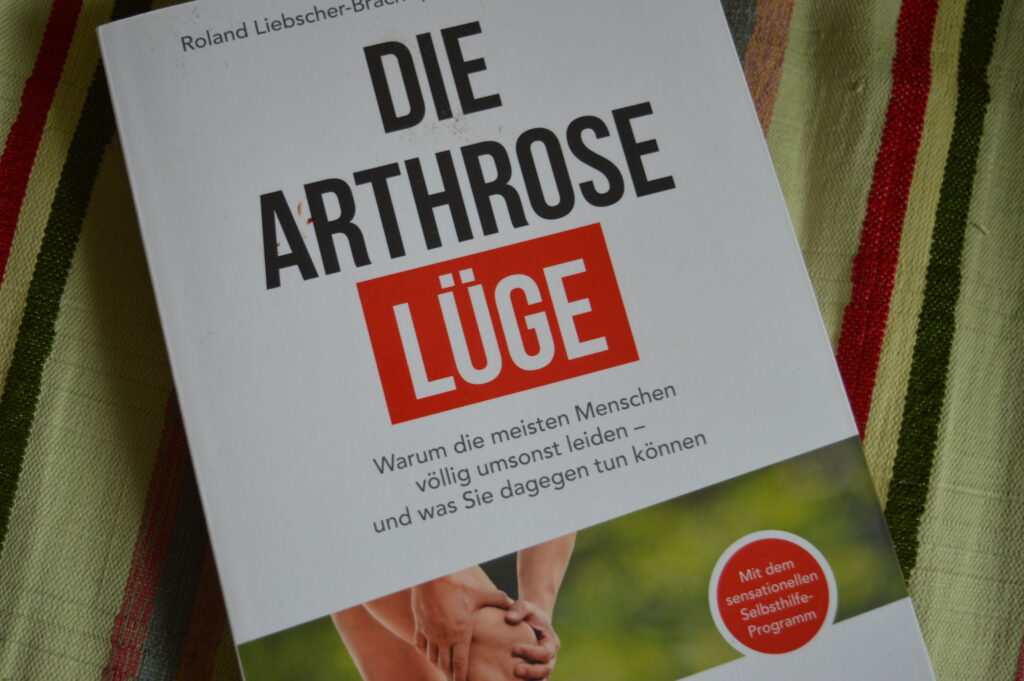
The osteoarthritis lie
Webseite: https://www.liebscher-bracht.com/
Youtube: https://www.youtube.com/c/LiebscherBrachtDieSchmerzspezialisten/videos
Instagram: https://www.instagram.com/liebscher.bracht/
.
Feldenkrais with Taro Iwamoto
Taro Iwamoto has interesting exercises for relaxation. My first experience with an exercise for the shoulders blew me away.
Since then I have been trying to learn and understand more about Feldenkrais.
One of the aims is to restructure the brain, for example by making the brain realise that it is using a muscle too much and that this is not necessary, so that the brain learns to store this information and implement it permanently. I have included the video here.
You can find more videos by Taro on his YouTube and Instagram channel below the video.
Youtube: https://www.youtube.com/c/TaroIwamoto
Instagram: https://www.instagram.com/taroiwamotofeldenkrais/
.

INTERVIES WITH PARKOURPHYSIO
Hello Parkour Physio,
I am delighted to have the opportunity to send you a few questions to learn more about your work as parkourphysio and to share the information in my library with others. Let’s get started.
Hello, how are you and what is your name?
My name is Miguel Ángel and I am enthusiastic about my project, even though I find myself in an environment outside my comfort zone that forces me to learn continuously through effort, dedication, many mistakes and few successes, but very valuable ones.
When did you start parkour and what was your reason for doing so?
I remember September 2007, when my friends and I discovered David Belle’s YouTube videos and loved the adventure of exploring all kinds of environments (both urban and natural). Years later, I would discover that I had already been exploring environments for years without knowing that it was called parkour.
How often do you train and how do you approach training?
I am currently going through a period of many changes in my life and I am experiencing a noticeable discontinuity, but I like to practise it 3 days/week or move around a little every day (I love to move around).
What exactly does your job as a physiotherapist involve?
The role of a physiotherapist is very limited in parkour, so in addition to being a physiotherapist, I am also a scientific researcher. This allows me to study, analyse and understand all the biomechanics involved in each parkour jump and the pathological mechanisms of its injuries. This is how I find the origin of each injury and the solution to get back to jumping, and I create the necessary knowledge to prevent others who practise it from suffering the same damage.
When and how did you come up with the idea of dealing with and analysing injuries in parkour?
En 2010 me lancé a la capital de Madrid a realizar un máster universitario, y allí se sumaron los buenos profesores de investigación que tuve, la comunidad de parkour increíble y mi pasión por aprender; y sentí que yo tenía algo que aportar al parkour
If you had to summarise the results of your analyses in one sentence, what would it be?
Around 80% of current parkour injuries can be prevented through scientific research into parkour.
What should parkour practitioners pay attention to when they go training?
Having a training plan designed by a coach (not an instructor) prevents you from continuously exposing your body to unbalanced loads (efforts), the accumulation of which is the most important cause of injury in parkour. And checking the health of your tissues is essential to prevent injuries and having to stop for months, because many of these tissues do NOT give warning signs.
What are the most common injuries and how do they happen?
Sprains, tendinopathies and fractures are the most notable; and they occur (in descending order of probability) in the ankle, knee and wrist.
What was the worst injury you have treated and how long did it take to recover?
Hmm… I remember an anterior cruciate ligament (ACL) tear that took us almost a year to recover from before I could return to parkour at 100%.
Is the risk of injury greater in parkour than in other sports?
According to the scientific analyses I have carried out over the last five years, no, today it is similar.
Are there ways to prevent injuries and, if so, what are they? (Nutrition, stretching, massages or similar)
Indeed, there are, and after more than seven years studying injuries based on science, I can say with great certainty that the three most important factors are (in descending order): sleep, nutrition, and training.
Do you think that professional parkour athletes set a good example when it comes to injuries? (Risk prevention, dealing with recovery, etc.)
Parkour as a sport is still very immature in all aspects, and there seems to be a rush to develop it (my mother always told me that things done in a hurry don’t turn out well). So they are a good example of how to take responsibility for your own health, but they still fall short in many other areas.
What tips would you give a beginner so that they can train for as long and as healthily as possible?
Try parkour with any qualified and experienced instructor, and if you enjoy it and want to further develop your psychomotor skills through parkour, seek out a specialised trainer who can guide you and look after your health with an expert who is up to date.
Thank you very much for your time and your answers. It was very interesting to read your answers and better understand your perspective. I wish you all the best and hope to see you again soon.

If you want to find out more about Parkourphysio, follow him on
Instagram: https://www.instagram.com/parkourphysio/
or YouTube: https://www.youtube.com/channel/UCnwh9oPtJ1Kztes7wECvspw
or visit his website: https://parkourphysio.com/equipo-de-investigacion/
(everything is in spanish).
.